
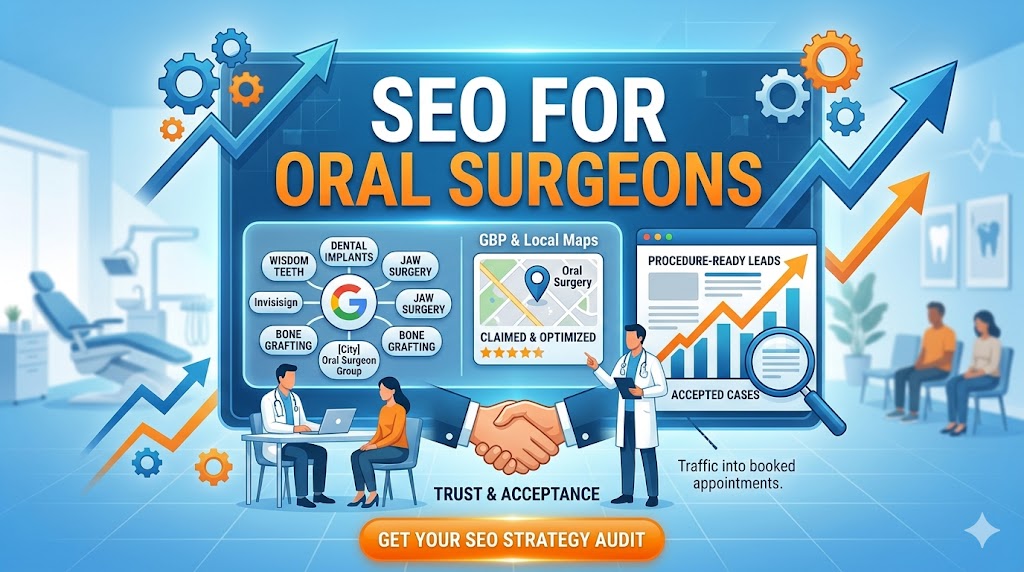

Oral surgery is not an impulse service. People search when they have a real need, a referral in hand, or a specific procedure in mind. That makes Google one of the highest-value channels for your practice.
A strong SEO strategy helps your practice appear for searches like:
These are not casual searches. They often come from people who are ready to schedule, compare providers, or confirm the right next step.
For oral surgeons, SEO can also help support referral behavior. A general dentist may already know your name, but a clean, trusted search presence still reinforces credibility. If a patient gets your practice name from a referral and then Googles you, your website needs to back up that trust quickly.
Google works well for oral surgery because it captures intent. Patients are usually searching because they need treatment, need information, or need reassurance before booking.
That search behavior often falls into a few categories:
 Patients searching by procedure
Some patients know exactly what they need. They may search for:
These searches are high intent because the person already understands the problem or the treatment category.
Other people search because something feels wrong. They may type in:
These users may not know the exact procedure yet, but they still need expert care.
Many oral surgery patients first hear about a practice from a general dentist, orthodontist, or another provider. Then they search the practice name, read reviews, and visit the website before calling.
That means your site must do more than exist. It must build confidence fast.
Here’s the key difference: a referral may open the door, but your website often helps close the case.
SEO is not about getting random traffic. It is about helping the right people find the right service at the right time.
For an oral surgery practice, that usually means improving visibility across procedure pages, local search, and referral-support content. A strong strategy can help your practice:
This matters because oral surgery decisions often involve urgency, trust, and high-value treatment. Your online presence should make the next step easy.
Many practices know they need better visibility, but they are not always sure what type of marketing will actually help. These are some of the most common questions behind the scenes.
Yes. Referrals are valuable, but they are not the full picture. Patients still search online after getting referred, and many also search on their own before ever speaking to a dentist.
SEO helps protect and strengthen both channels:
It can. When your site is optimized around the procedures you want to grow, you are more likely to attract traffic tied to those services. Better page structure and stronger procedure content usually lead to more relevant inquiries.
In most cases, yes. If your site groups implants, extractions, bone grafting, sedation, and jaw surgery into one general page, it becomes harder to rank well and harder for patients to find what they need.
Absolutely. Even highly specialized practices rely on geographic relevance. Patients and providers usually want a surgeon within a reasonable distance, and Google heavily considers location in search results.
If local visibility is part of your growth plan, our guide on increasing your Google Maps radius for a small business offers useful context on how local discovery works.
A good oral surgeon SEO strategy should match your practice goals, procedure mix, and market. It should also support how real people search, not just broad industry terms.
Here are the core areas that may be included.
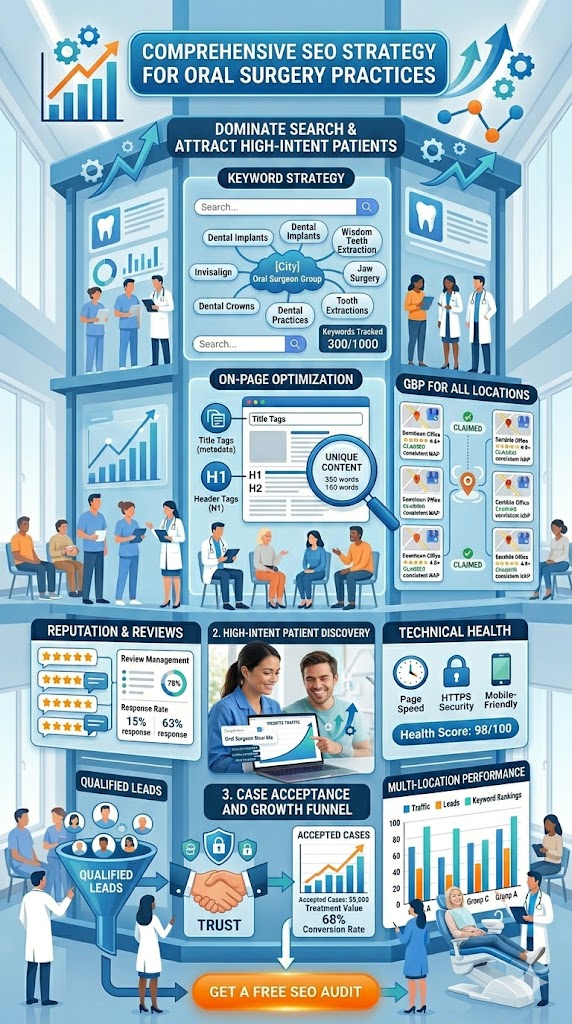 Local SEO
 helps your practice appear in searches tied to your city, region, and nearby service areas. This includes both map visibility and organic search presence.
For oral surgeons, local SEO supports searches from:
Each major service should have its own clear, useful page. That gives search engines more context and gives visitors a better experience.
These pages may include topics such as:
Good procedure pages answer real patient questions while also improving ranking potential.
On-page SEO improves how each page is written, organized, and presented. This often includes:
These fixes help both rankings and conversions.
Technical issues can limit visibility even when the content is solid. A technical review looks for problems that may affect crawling, indexing, and performance.
That may include reviewing:
If your site is new or was recently redesigned, it may help to review how long it takes a new website to show up in Google Search and how long it takes to get a page indexed.
Helpful content builds trust before someone ever contacts the practice. It can also support rankings for longer-tail searches tied to procedures, recovery, and patient concerns.
Good content may answer questions like:
This type of content supports both patient education and search relevance.
A strong site should guide users naturally from one page to another. Someone reading about implants should be able to move to a consultation page, a contact page, or related treatment content without friction.
Internal linking also helps search engines understand which pages matter most. That is especially useful for procedure-heavy websites.
Now that you know what tactics may be included, the next step is knowing what “good” looks like.
A strong oral surgery website should include:
In short, your website should not feel like an online brochure. It should work like a patient acquisition tool.
Many practice websites struggle with the same avoidable issues. Fixing these often creates early momentum.
 Relying on one generic services page
If every procedure is buried on one broad page, search engines have less clarity and patients have less confidence. Break out major services into dedicated pages.
SEO copy should still sound natural. If the page feels stuffed with keywords or vague medical marketing language, users will leave.
Even referred patients often search before calling. Make sure your website supports trust with clear service information, professional messaging, and an easy next step.
If important pages are isolated, they are harder for users and search engines to find. Connect related pages intentionally.
Healthcare-related content should be accurate, useful, and well written. If your team is evaluating AI-assisted content, read our take on whether ChatGPT content can negatively affect SEO.
SEO is not instant, but it can become one of the most reliable long-term growth channels for an oral surgery practice.
Results may include:
The timeline depends on your market, competition, current site quality, and how much work has already been done. Early gains often come from improving page structure, creating stronger service pages, and fixing technical issues. Larger gains usually build over time.
Quick recap:
 There are plenty of agencies that say they offer SEO. What matters is whether they can build a strategy that fits your specialty, your goals, and the way patients actually search.
At GoMediaNC, we focus on practical work that helps service-based businesses get found and convert more traffic into real leads. We do not rely on vague promises or bloated reports. We focus on clarity, usability, and outcomes.
Oral surgery is not like selling a product online. Patients are making trust-based decisions, often under stress, and often with a referral in hand. Your website needs to match that reality.
Some users search by procedure. Others search by urgency. Others search your name after a referral. We help shape your site so it supports all three.
Good SEO content should answer questions, reduce friction, and move the visitor toward a clear next step. That is especially important for high-value treatment pages.
If your practice needs broader support beyond one service page, our SEO agency services in North Carolina and web design and SEO services may also be relevant.
You may also find overlap with related specialty service pages like dental group SEO and Google Search marketing and orthodontist SEO and Google Search marketing.
A strong oral surgery practice should be easy to find when patients and providers search for the procedures you offer. If your website is not helping bring in the right opportunities, it may be time to improve the way it works.
Go Media NC helps practices build stronger search visibility, better service pages, and clearer patient-focused messaging. Start by reviewing your top procedures, identifying your weakest pages, and improving the path from search to consultation.

Contact Go Media NC to discuss your current website, your goals, and the smartest next steps for your search marketing strategy.