
Most business owners know their industry inside and out. You know the technical names for what you do, the products you carry, and the way professionals in your field talk about their work. The trouble is that your customers don’t talk that way. They type what’s on their mind, and what’s on their mind is usually a problem, not a service.
That gap between how you describe your business and how customers search for it is where keyword research lives. Close the gap, and your website starts showing up for the searches that actually turn into customers. Leave it open, and you can have a beautiful site that nobody finds.
Here’s how to think about keywords the way your Raleigh customers do.
Keywords Are Questions in Disguise
Every search is someone asking for help. “Emergency dentist Raleigh” is a person in pain. “How much does a kitchen remodel cost in Cary” is a homeowner trying to budget. “Best CPA for small business near me” is a founder who just realized tax season is coming. We see the same split in SEO for orthodontists and local SEO for dentists, where the clinical term and the patient’s phrase almost never match.
When you look at keywords this way, the job gets clearer. You’re not trying to trick a search engine. You’re trying to figure out what your customers need, in their words, and then make sure your website answers them.
Start by Listening, Not Searching
Before you open any tool, spend a week paying attention to how people describe their needs when they call or walk in. Write down the exact phrases. Ask your front desk what questions come up over and over. Read your reviews and look at the words customers use to describe what you did for them.
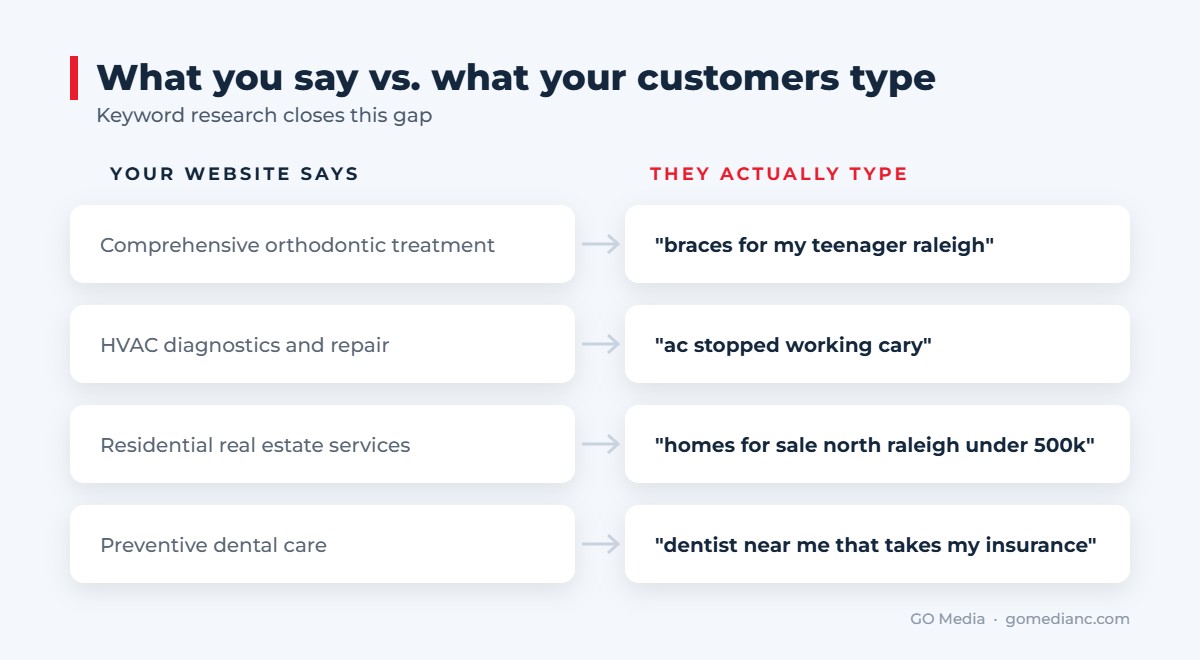
You’ll notice something quickly. Customers say “braces for my teenager” while your website says “comprehensive orthodontic treatment.” They say “my AC stopped working” while your service page says “HVAC diagnostics and repair.” Those customer phrases are your starting keywords, and they’re worth more than anything a tool spits out because they come straight from the people you want to reach.
Add the Local Layer
Now think about geography. Raleigh customers search in several ways. Some add the city name: “family photographer Raleigh.” Some add their part of town: “pediatric dentist North Raleigh” or “auto repair Brier Creek.” Many just add “near me” and let their phone handle the rest, which is exactly the behavior that feeds Raleigh’s map pack results.
Your keyword list should reflect all three patterns, and it is the backbone of any serious local SEO campaign in Raleigh. A list of core services crossed with the areas you serve gives you a map of pages your website might need. If you serve Raleigh, Cary, Apex, Wake Forest, and Garner, that’s a real difference in how people search, and a website that acknowledges those places will connect with more of them.
Understand Intent Before You Chase Volume
Tools will show you how many people search a phrase each month, and it’s tempting to go after the biggest numbers. Resist that. A phrase like “orthodontics” gets searched constantly, but most of those searches are students, curious readers, and people nowhere near Raleigh. A phrase like “Invisalign consultation Raleigh” gets searched far less, but nearly everyone typing it is a potential patient. That distinction is the whole basis of Invisalign SEO.
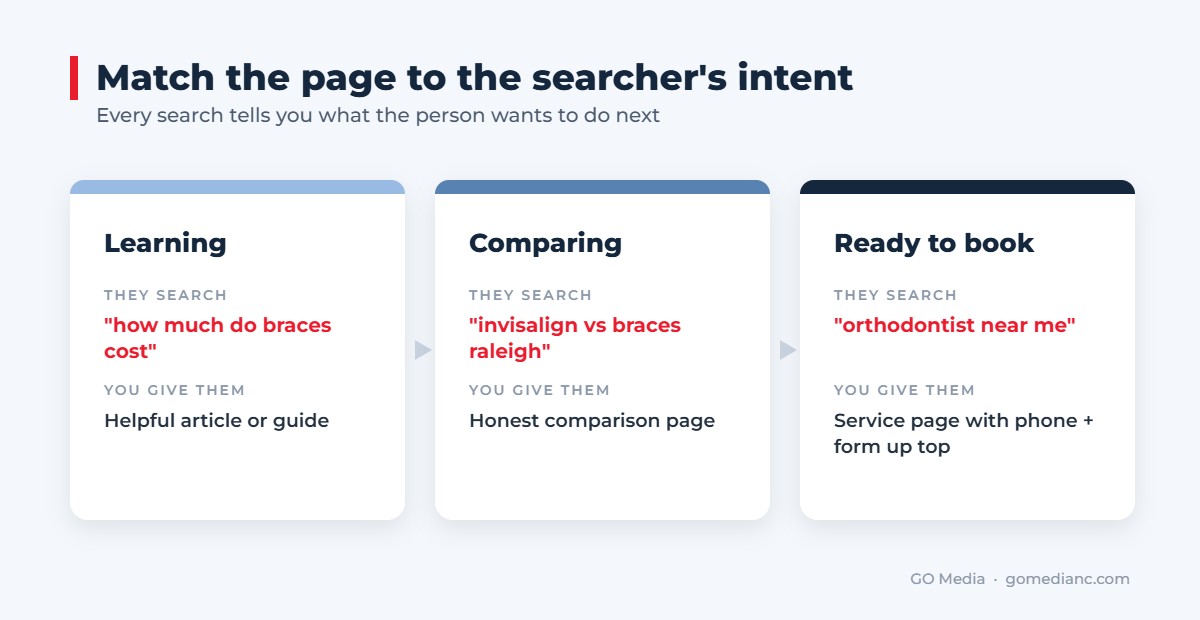
Ask yourself what the searcher wants to do next. Are they learning? Comparing? Ready to buy or book? Each type of intent deserves a different kind of page. Educational searches want a helpful article. Comparison searches want honest information about options and pricing. Ready-to-buy searches want a clear service page with a phone number and a form right at the top.
Use Tools to Confirm, Not to Lead
Once you have a list built from real customer language, tools become useful. Google’s own search bar shows you autocomplete suggestions as you type. The “People also ask” box on results pages reveals related questions. Google Search Console, which is free, shows you the exact phrases your site already appears for, including ones you never planned on. Paid tools like Semrush or Ahrefs add search volume estimates and show you which keywords your competitors rank for.
Use these to fill in gaps and to check your assumptions. Sometimes you’ll find a phrase you never considered that hundreds of people in Wake County search every month. Sometimes you’ll find that a term you thought was important barely gets searched at all.
Look at Who’s Already Ranking
Search your most important keywords and study the first page. Who shows up? What kind of pages are they, service pages, blog posts, directories? How long are they? What questions do they answer?
Google is showing you what it believes satisfies that search. If the whole first page is detailed guides and you’re trying to rank a two-paragraph service page, you’ve learned something important. You don’t have to copy anyone, but you do have to meet the standard the search has already set, and then find a way to be more useful.
Turn Keywords Into a Plan
A keyword list is only valuable when it becomes pages. Group your keywords by topic and intent. Each group typically maps to one page: a service page for the ready-to-book phrases, a location page for the geographic ones, and a blog post or guide, written with real SEO copywriting, for the questions.
Then prioritize. Start with the keywords that are closest to a sale and that you have a realistic shot at ranking for. A new Raleigh business probably won’t outrank a national chain for “dentist” this year, but it can absolutely win “emergency dentist Wake Forest” with the right page and a handful of good reviews.
Revisit Your List Every Few Months
Search behavior changes. New neighborhoods get built. People start asking about services you didn’t offer last year. Search Console will show you new phrases popping up, and a quick quarterly review keeps your site aligned with how Raleigh is actually searching right now.
How GO Media Approaches Keyword Research
When we take on SEO for a Raleigh business, keyword research is where we start, and we do it the way we’ve described here. We listen to how your customers talk, layer in the local geography of the Triangle, sort everything by intent, and then verify it with data. What you get isn’t a spreadsheet of a thousand phrases. It’s a focused plan that tells you which pages to build, what to say on them, and which searches you should expect to win first.
If you’ve ever wondered why your website isn’t bringing in the customers it should, the answer often starts here. Reach out to GO Media and we’ll show you what your customers are typing and how to meet them there.