
Here’s a small experiment. Pull up your website on your phone, but don’t use your office Wi-Fi. Use your cell signal from the parking lot, or better yet, from somewhere with a weak connection like the back of a building off Capital Boulevard. Count how long it takes before you can read something and tap a button.
If you got past three seconds, you just experienced what a lot of your potential customers experience. And most of them don’t wait. They hit back and tap the next result.
Site speed and the technical health of your website aren’t glamorous topics, but they’re the foundation everything else in SEO sits on. Once it’s solid, content that answers real customer questions is what earns the rankings. Google notices when your site is slow, hard to use on a phone, or full of broken pieces, and it quietly hands those customers to a competitor. Let’s fix that.
What “Technical SEO” Really Means
Technical SEO is the behind-the-scenes work that lets search engines find, read, and trust your website. If content is what you say and keywords are the words you use, technical SEO is whether the building is structurally sound enough for anyone to walk through it.
It covers things like how fast pages load, whether the site works well on mobile devices, whether Google can crawl every important page, whether your site is secure, and whether the code is clean enough that nothing gets in the way. None of it is visible to a customer when it’s done right. All of it is painfully visible when it’s done wrong.
Speed Is a Customer Experience Problem First
Google measures speed through a set of metrics called Core Web Vitals. The names are technical, but the ideas aren’t. One metric asks how long it takes for the main content to appear. Another asks how quickly the page responds when someone taps something. A third asks whether the layout jumps around while loading, which is that annoying moment when you go to tap a button and it moves.
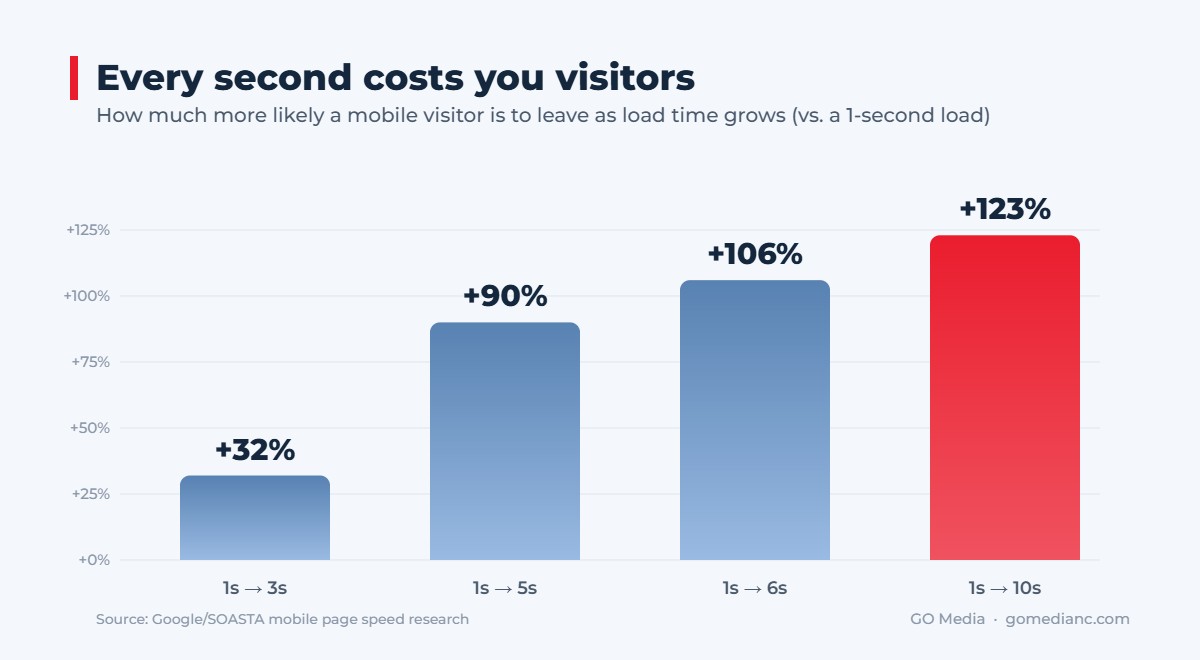
These matter for rankings, but they matter more for people. Research from Google has consistently shown that as load time grows from one second to three, the odds of someone leaving jump significantly. Every second you shave off is a customer who stays long enough to see what you offer.
The Usual Suspects Behind a Slow Site
When we audit websites for Raleigh businesses, the same culprits show up again and again:
- Oversized images. A photo straight off a camera can be several megabytes. Your website needs a version that’s a fraction of that size, and it needs to be served in a modern format.
- Too many plugins. Each one adds code that has to load. Sites often carry a dozen plugins that were installed for a single feature years ago and never removed.
- Cheap or overloaded hosting. A bargain hosting plan shares a server with hundreds of other sites. When they’re busy, you’re slow.
- Bloated themes and page builders. Some design tools load an entire library of features on every page whether you use them or not.
- Third-party scripts. Chat widgets, tracking pixels, embedded videos, and social feeds each make their own requests before your page finishes loading.
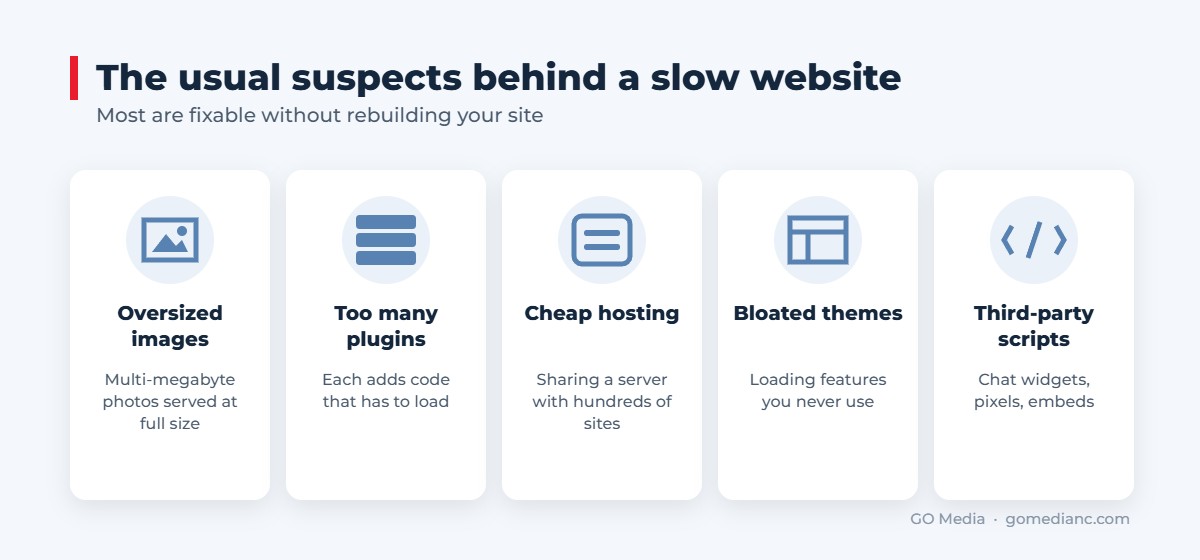
The good news is that most of these are fixable without rebuilding your site. Compressing images, removing unused plugins, adding caching, and moving to solid hosting often cut load times in half.
Mobile Isn’t a Version of Your Site. It Is Your Site.
Google now looks at the mobile version of your website first when deciding how to rank it. That’s because most searches, especially local searches, happen on phones. Someone searching for a chiropractor in Cary is far more likely to be on their phone than at a desk.
Open your site on a phone and be honest. Is the text readable without zooming? Are the buttons big enough to tap with a thumb? Does the menu work? Can someone call you with a single tap? If your phone number is just text, or your contact form requires pinching and scrolling, you’re losing people at the last step. This is where thoughtful web design in Raleigh, NC pays for itself.
Make Sure Google Can Find Every Page
Search engines discover your pages by following links and reading a file called an XML sitemap. If an important page isn’t linked from anywhere and isn’t in your sitemap, it might as well not exist. It’s surprisingly common to find service pages that were built, never linked in the navigation, and never indexed. If your site is new, it helps to know how long a new website takes to show up in Google search and how long it takes to get a page indexed.
Google Search Console, a free tool, will tell you which pages Google knows about and which ones it had trouble with. Spend fifteen minutes in there and you’ll often find quick wins: pages accidentally blocked from search, broken links, or duplicate pages competing with each other.
Security Is Part of Trust
Your site should load over HTTPS, with the little padlock in the browser. Google has treated this as a ranking signal for years, and browsers now warn visitors when a site isn’t secure. Beyond that, keep your software updated. An out-of-date site is an easy target, and a hacked website doesn’t just hurt your rankings. It can get you removed from search results entirely until it’s cleaned up.
Help Google Understand Your Business With Structured Data
Structured data is a bit of code that labels the information on your pages so search engines don’t have to guess. It tells Google, “This is our business name, this is our address in Raleigh, these are our hours, these are our reviews.” When it’s set up correctly, your search listing can show star ratings, hours, and other details that make it stand out from the results around it. It’s a small technical step with an outsized visual payoff.
Where to Start If You’re Overwhelmed
You don’t need to fix everything at once. Run your site through Google’s free PageSpeed Insights tool and look at the mobile score. Compress your images. Delete plugins you don’t use. Check Search Console for errors. Make sure your phone number is tappable. Those five steps alone will put you ahead of most of your Raleigh competitors.
How GO Media Handles the Technical Side
We build websites with speed and search built in from the start, and we audit existing sites to find what’s dragging them down. That means fast hosting, clean code, properly sized images, mobile-first layouts, structured data, and ongoing maintenance so your site stays healthy after launch. We track Core Web Vitals and Search Console alongside your rankings, so when something slips, we catch it before your customers do.
If your website feels slow, or you simply don’t know how it’s performing, reach out to GO Media. We’ll run a website SEO audit, explain what we find in plain language, and show you what fixing it would mean for your business.